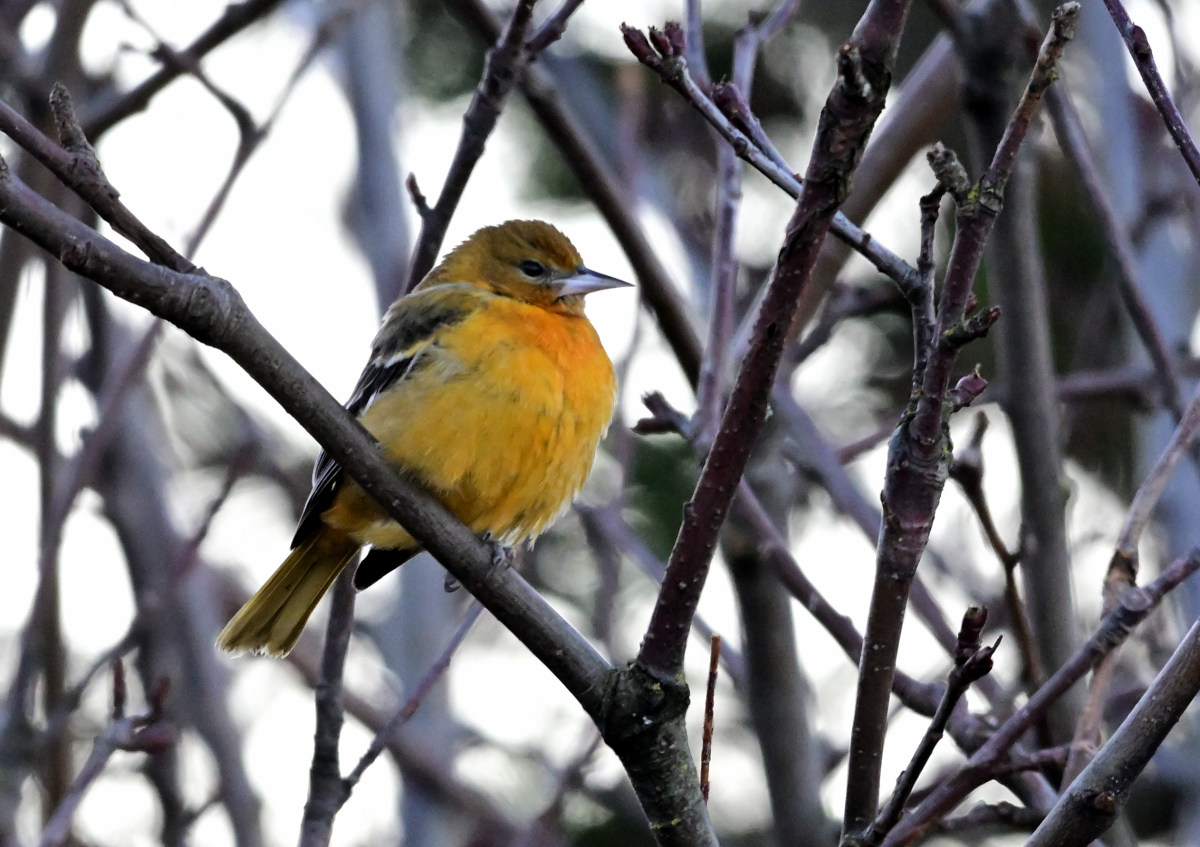
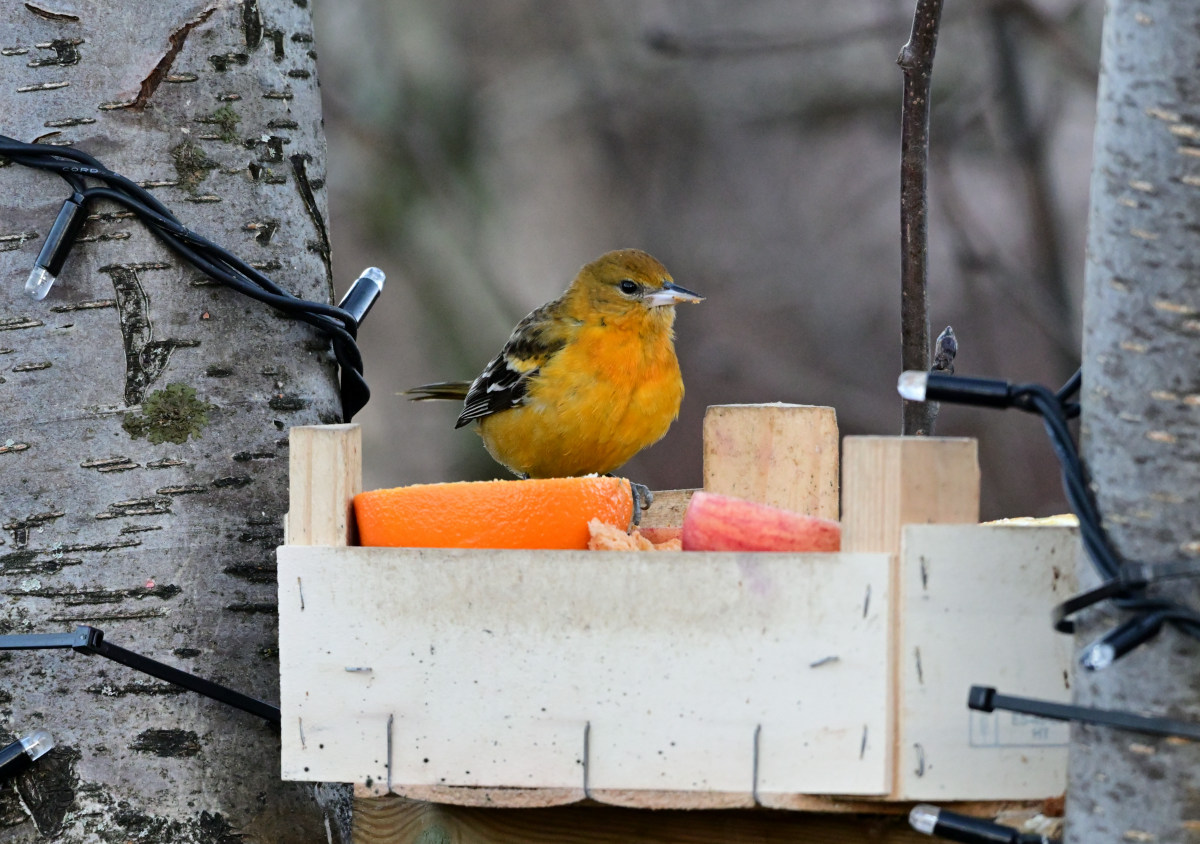
A Baltimore Oriole was spotted for the fifth time in Iceland in the middle of November. The last sighting was in 2003. The bird has stayed rouhgly in the same area since then, in the eastern part of the capital area, first in Seljahverfi in Reykjavík and later in Lindahverfi in Kópavogur. This seems to be a tough bird having survived all kinds of winter weather in a group of Redwings roaming between gardens for feed.
Oranges are a favourite of the Baltimore Oriole
The Baltimore Oriole is a common migratory breeding bird in eastern North America, overwintering mostly in South and Central America. They are often seen in leafy treetops but seldom deep in forests. Their main habitat are open woodland areas but they are very adaptable and have also been breeding in orchards, farmlands and suburban areas where there are enough trees for them.
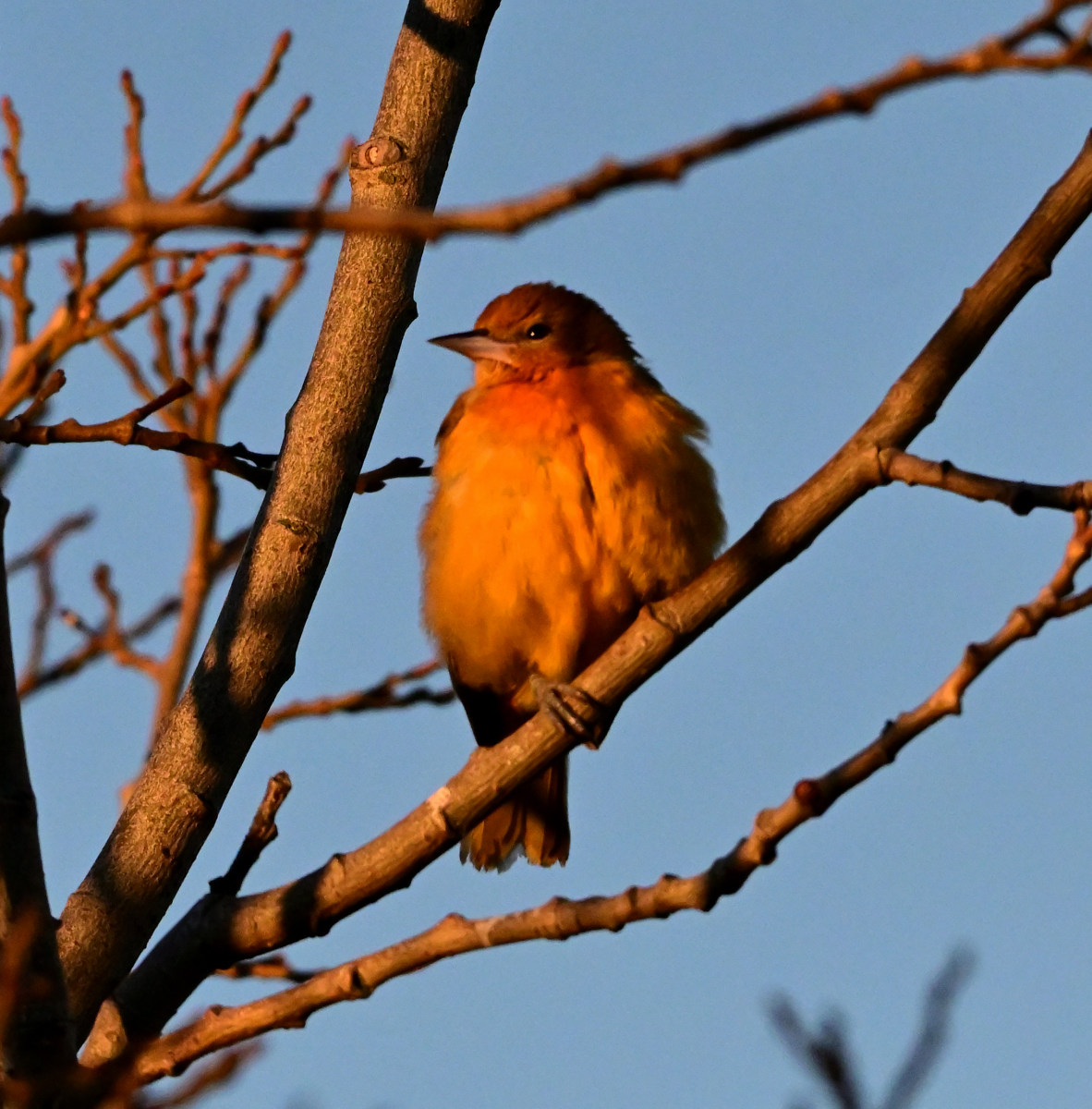
In the morning sun
These photoes were taken at a residential street Haukalind in Kópavogur on January 3, 2026. The Oriole was very much alive in the company of Redwings.
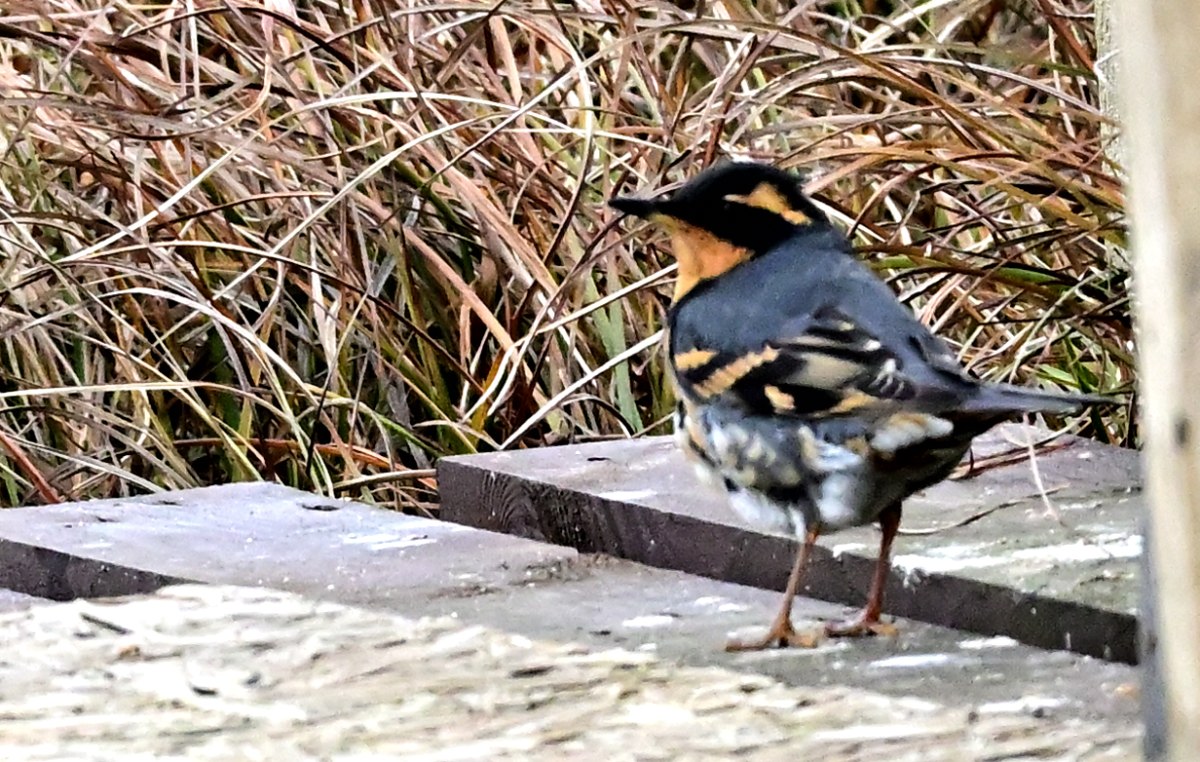
An American Varied Thrush was spotted in the so-called “Búgarðabyggð” south of Selfoss on October 25 – 26. This is the second bird recorded in Iceland. The first one was recorded in Northeast Iceland in May 2004.
The American Varied Thrush is a breeding bird in western North America, from Northern California to Alaska, with wintergrounds on the west coast of the United States. In other parts of North America it as a rare vagrant and very rare in Europe.
I wasn’t very successful in photographing the bird 🙂
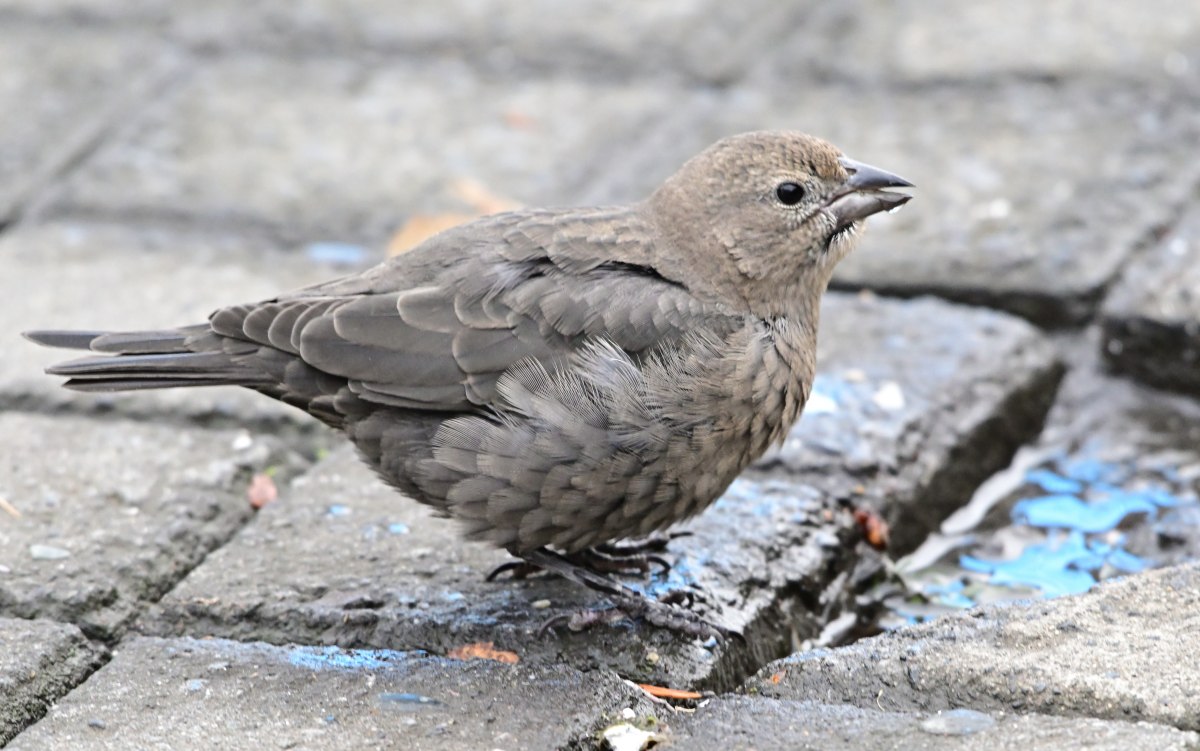
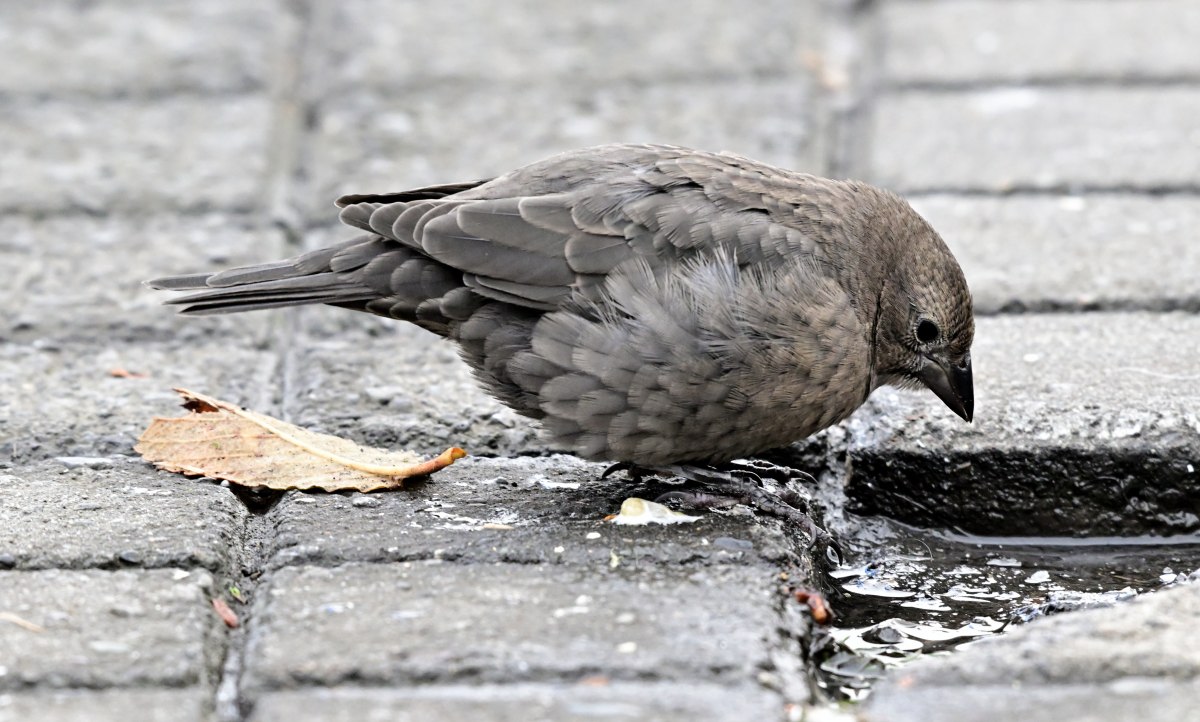
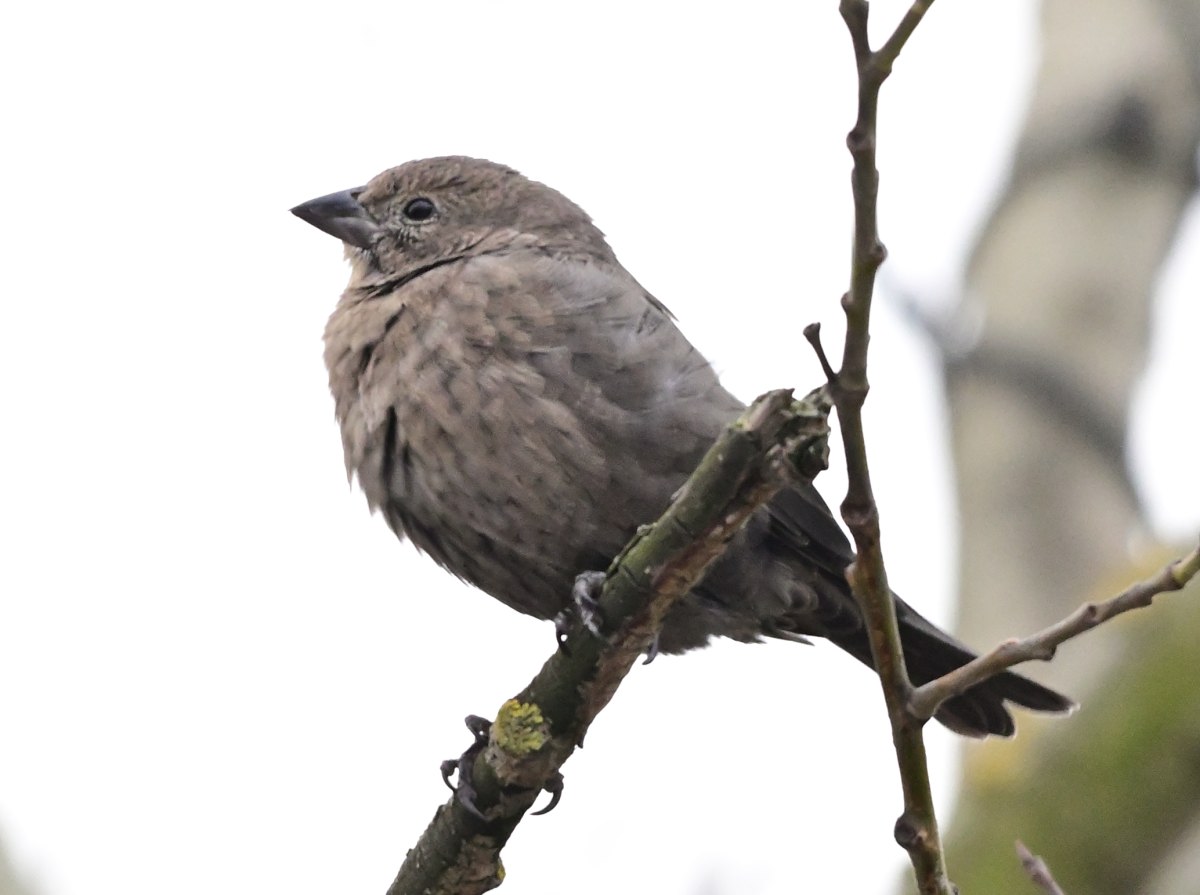
A Brown-headed Cowbird was seen for the first time in Iceland on October 24. This female bird was first spotted by a birder outside Eymundsson, a bookstore, in the centre of Reykjavík. Now a month later it is still there. This vagrant was probably blown here by heavy Southwest winds in the end of September along with a group of other American birds seldom or never seen here before.
The Brown-headed Cowbird is common in North America and the stock has grown in numbers and range as towns expand and woods are cleared.
The Brown-headed Cowbird has a peculiar way of raising its chicks. The females produce a lot of eggs, sometimes more than three dozens. These they lay in the nests of other birds, leaving their eggs to be hatched and their young to be raised by foster parents. Often at the expense of the foster parents own chicks.
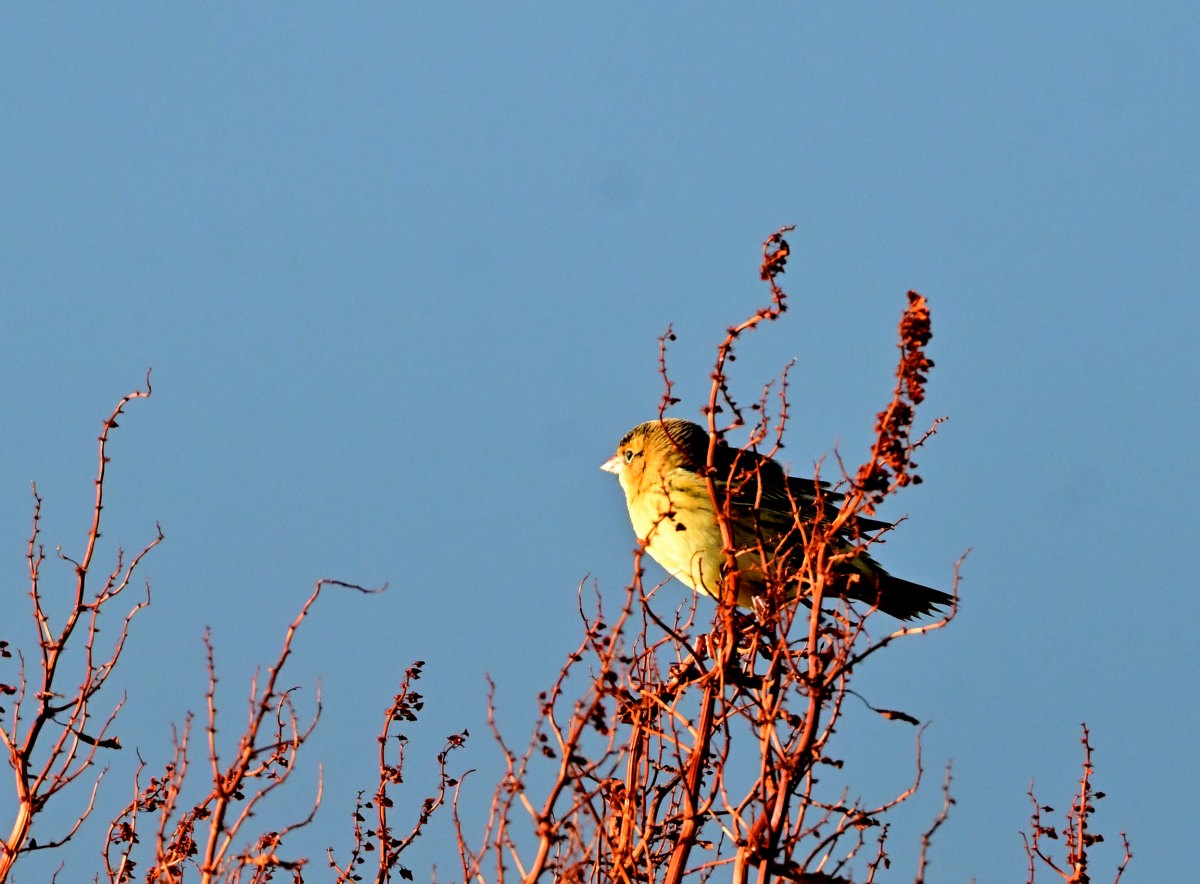
The Bobolink, formerly named the Rice bird, is a new species for Iceland. This female bird was spotted October 4 in Reykjanes Peninsula near the small town of Garður. It is a breeding bird in North America with wintergrounds in southerly parts of South America. The stock is declining due to habitat loss and in many places it is not a welcome guest as it feeds on cultivated grains in winter and during migration.
Among American passerines the Bobolink is the bird that flies the longest distance to its wintergrounds, flying about 20,000 km from Canada to South America.
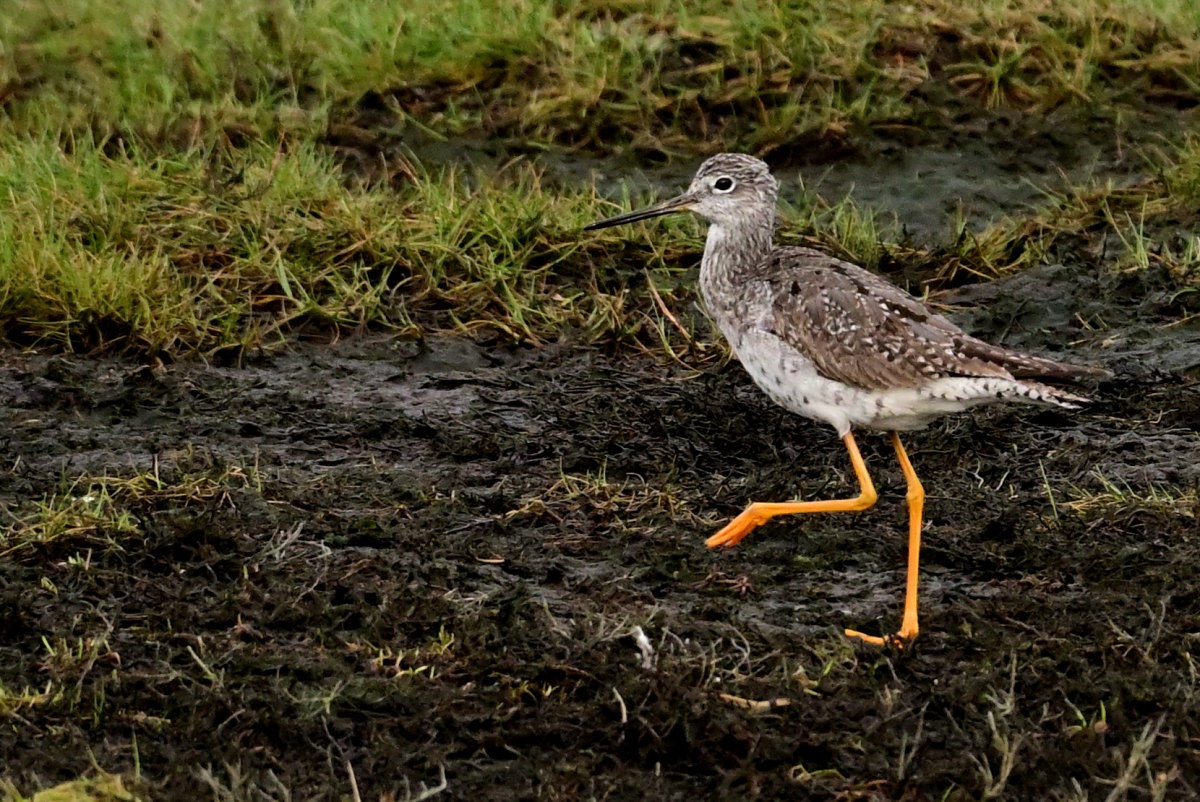
This Greater Yellowlegs was spotted in Grindavik in the beginning of October. This is the third time a sighting is recorded in Iceland, previously in 1961 and 1966. Thus a first for all Icelandic birders today and a great treat.
The Greater Yellowlegs breeds in wetlands in the boreal forests of Canada and Alaska. They migrate to the coasts of the United States, the Caribbean, and South America. They mainly eat insects, worms, frogs, small fish, seeds and berries. The Greater Yellowlegs is a very rare vagrant this side of the Atlantic.
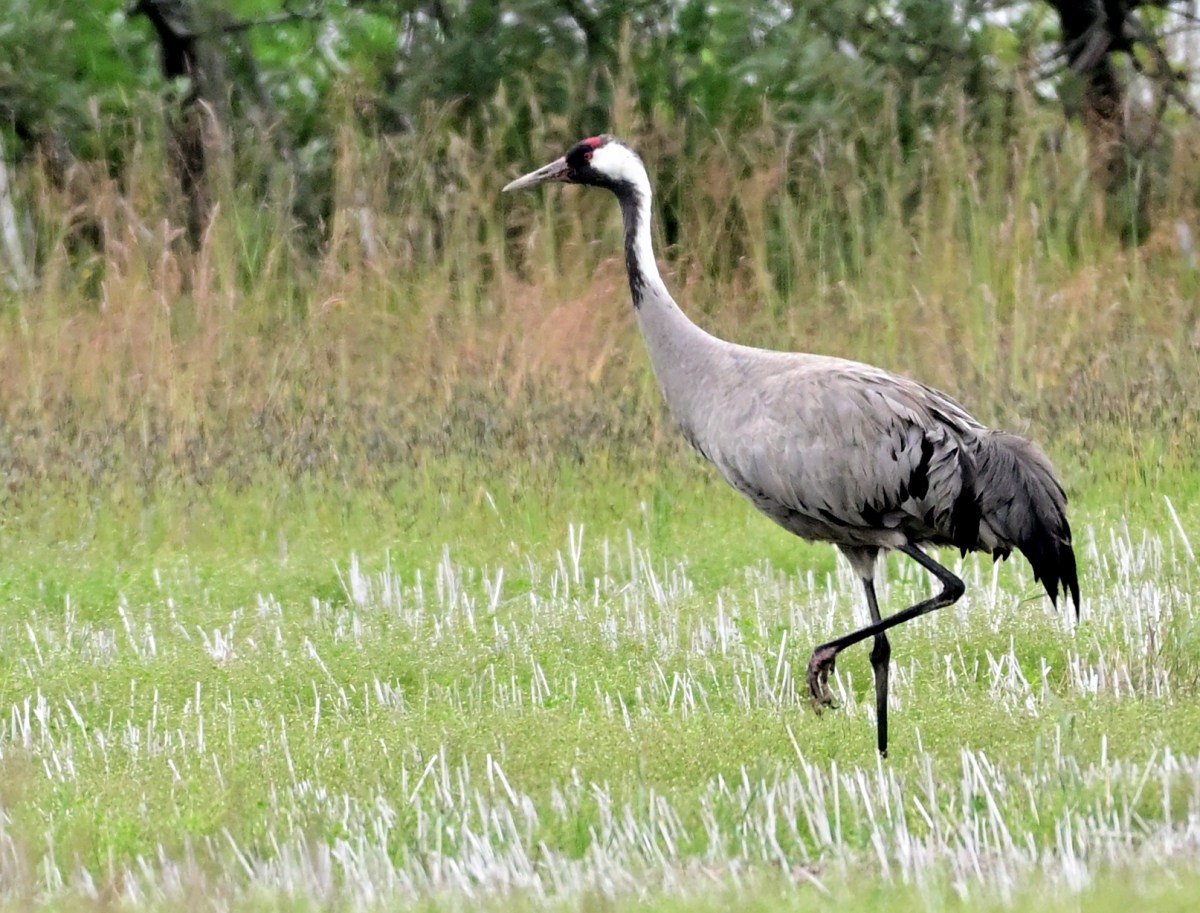
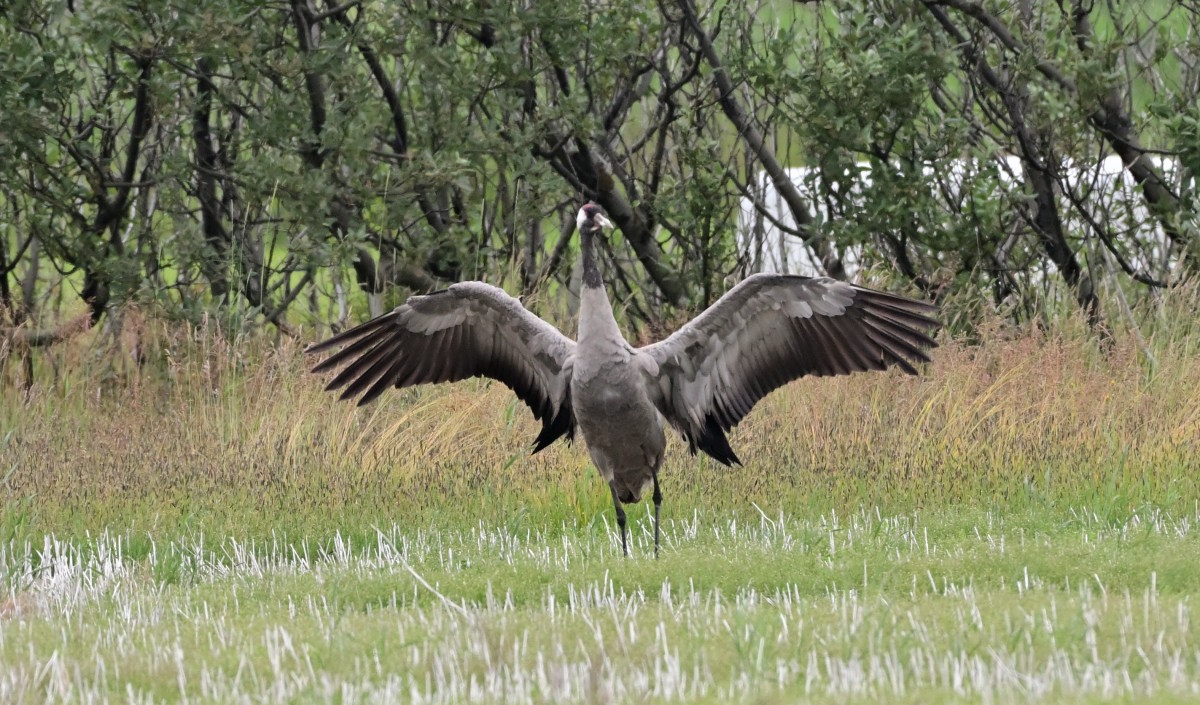
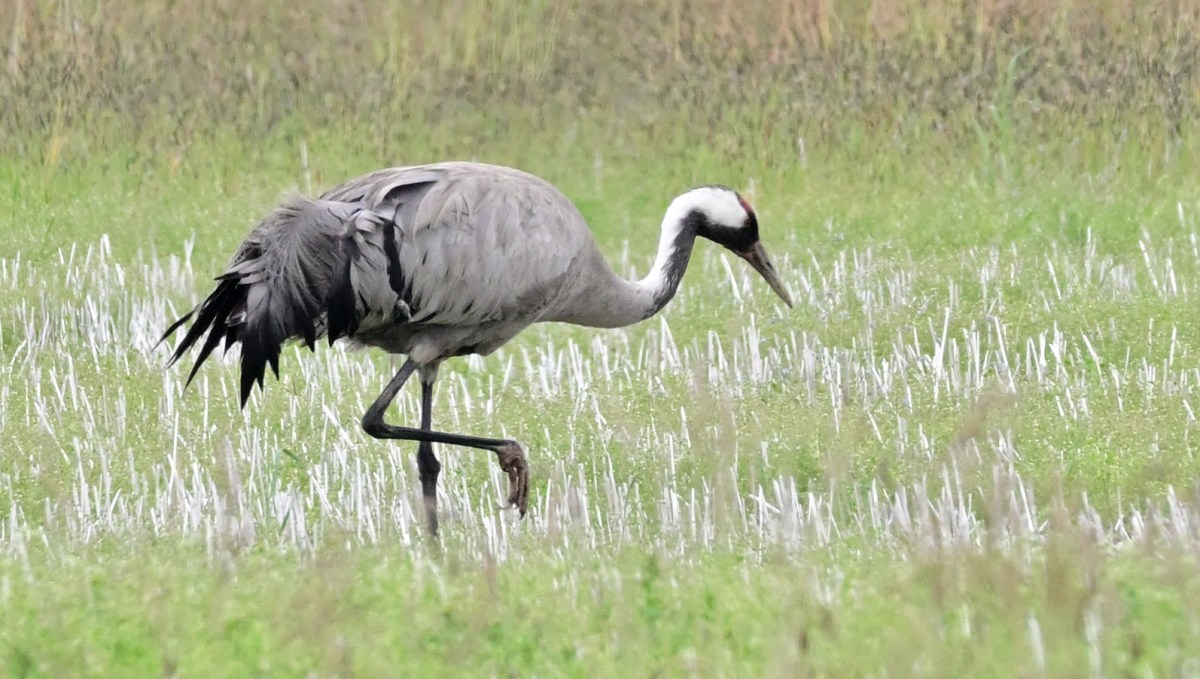
The Common Crane is far from common in Iceland. It is an annual but rare vagrant. One has been spotted in the last few days in Gunnarsholt in Rangárvellir, South Iceland. In recent years, however, a pair has bred in the East so perhaps an Icelandic stock is on its way.
Grátrana – Common Crane / Eurasian crane – Grus grus
The Common Crane is a big bird, 100-130 cm tall and has a wingspan of 180–240 cm. It can reach the age of 30 – 40 years. It lays two eggs and two chicks were reported a few years ago in East Iceland.
The Common Crane’s main breeding place spreads from Europe to Siberia, the biggest population in Russia, Finland and Sweden. They migrate south for winter.
The Common Crane breeds in various surroundings, in forests and in wetlands, in moors and by lakes, in lowlands up to elevations of 2,200 m.
Spring is here. Seeing the migrans arriving every day is such an exciting time. Most of them are here by now, although we have not yet spotted the Wheatear. But sightings of the Red Phalarope and Red-Necked Phalarope have not yet been reported.
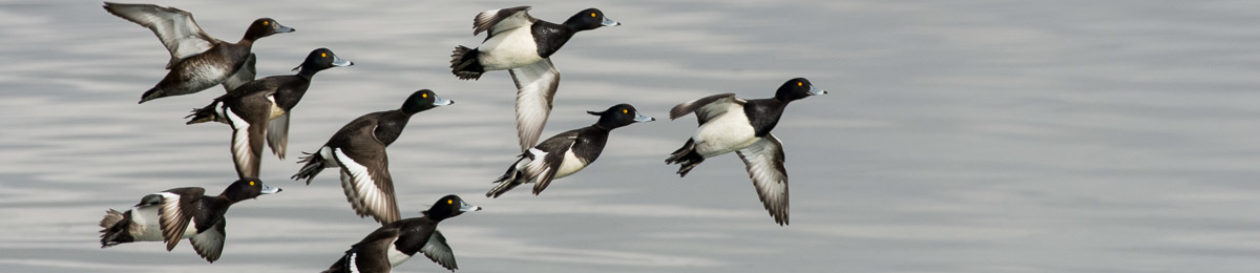
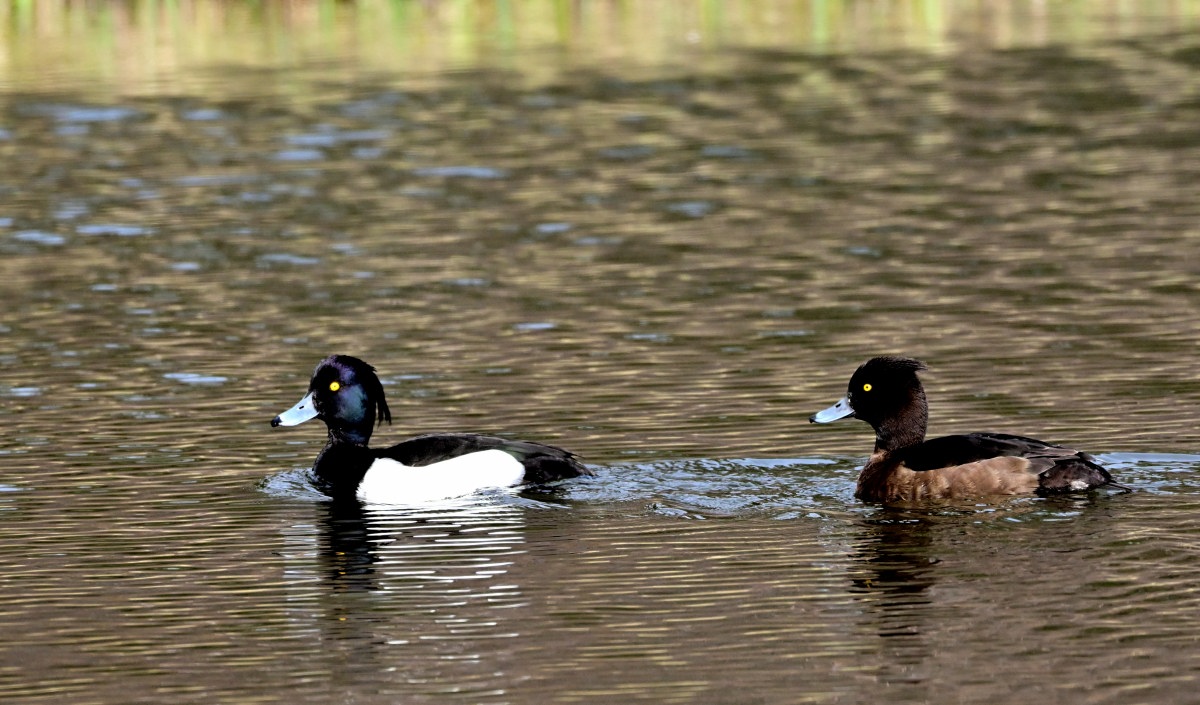
Skúfönd – Tufted Duck – Aythya fuligula
These Tufted Ducks were in Lake Þingvellir this week. This is a small diving duck and a common breeding bird in Iceland. In winter some of them choose to stay on lakes and ponds that do not freeze but most migrate to the British Isles and South Europe in winter.
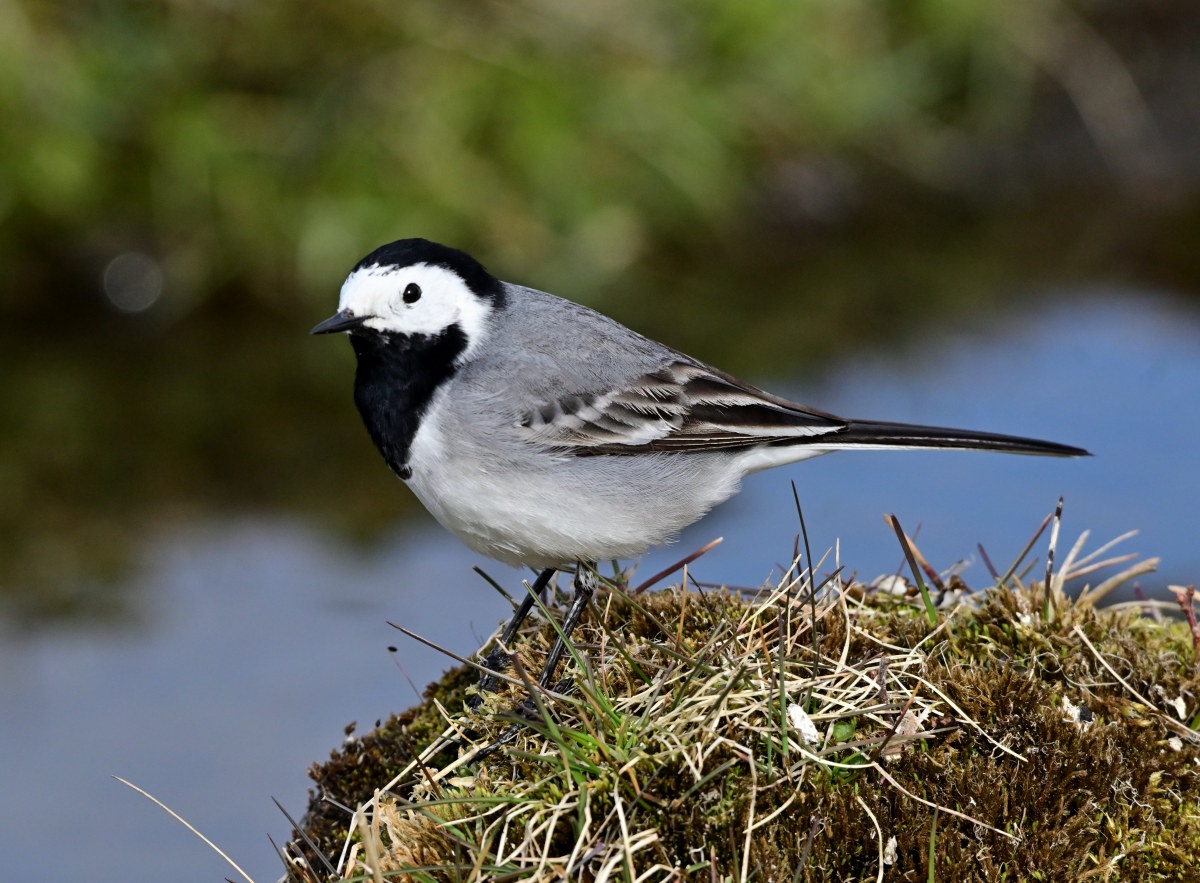
Maríuerla – White Wagtail – Montacilla alba
This beautiful Wagtail was also at Lake Thingvallavatn and eager to be photographed. It has come all the way from its wintergrounds in West Africa. The pair that has come to our garden for years has not arrived. We hope they have moved but not perished.
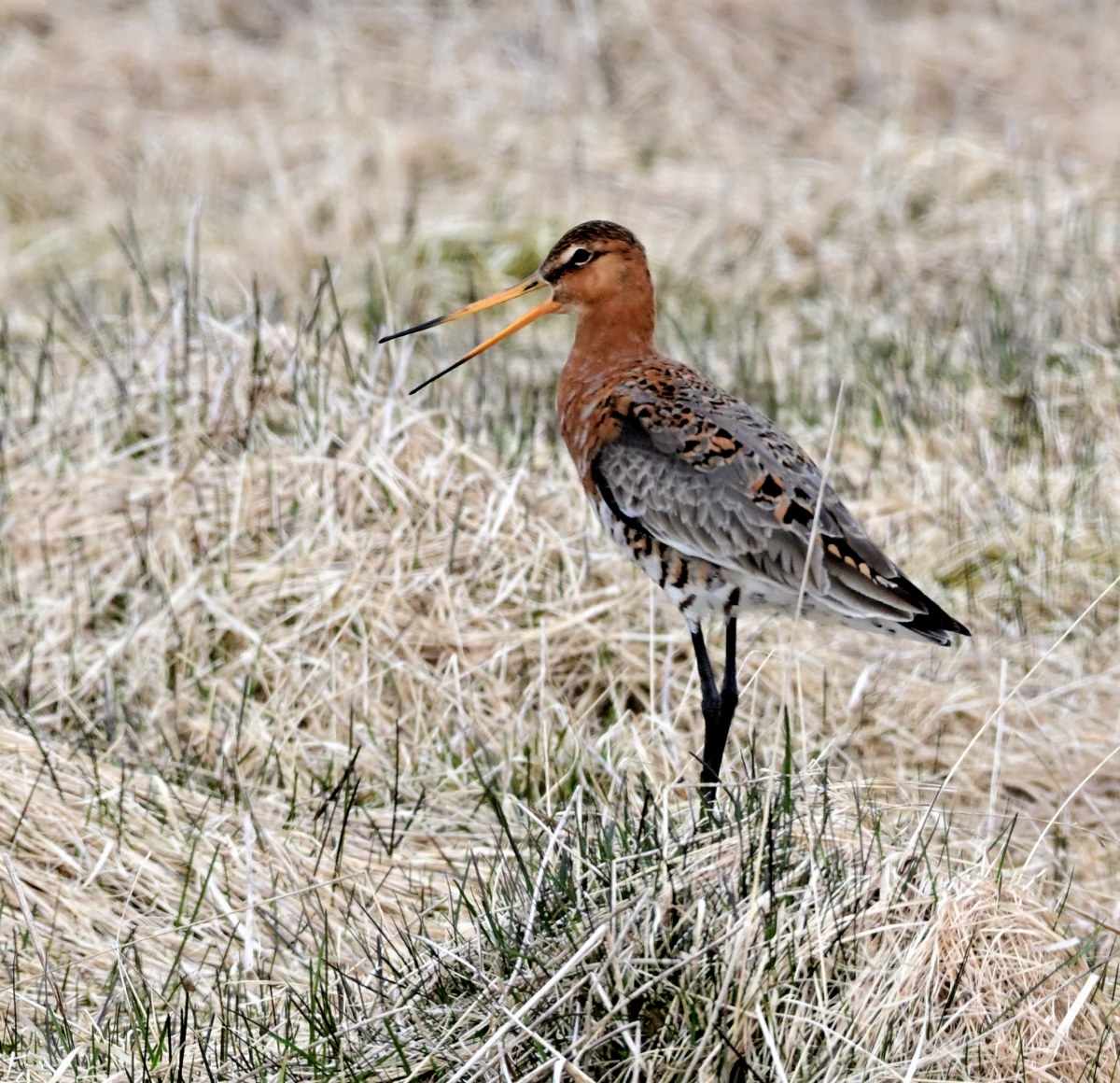
Jaðrakan – Black-Tailed Godwit – Limosa limosa
One of the migrants arriving in flocks is the Black-Tailed Godwit with its beautiful colours and shrill song. It overwinters on the west coast of Europe, from The Netherlands to the shores of Portugal. Our special Icelandic subspecies mostly breeds in lowlands all over Iceland. They also breed in the Faroe Islands, Shetlands and Lofoten.
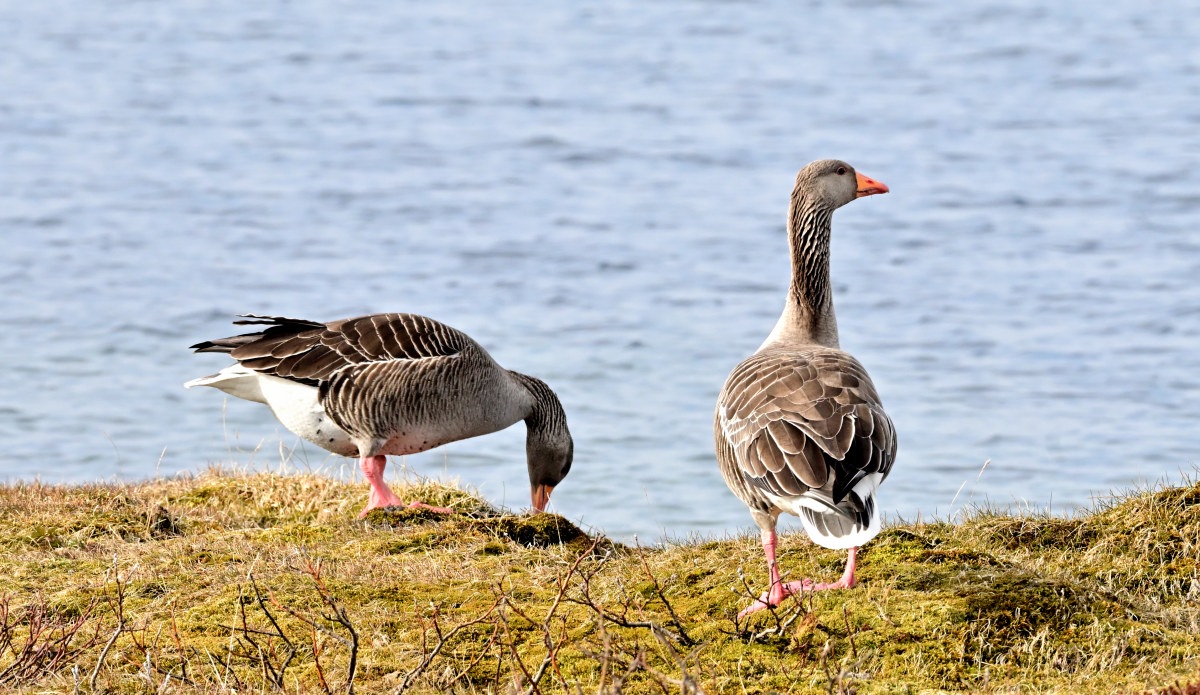
Grágæs – Greylag goose – Anser anser
Most Greylags overwinter in the British Isles but some decide to struggle through the winter here in Iceland. This pair along with a lot of others have taken up residence by Lake Thingvallavatn. Their population is decreasing whereas their cousines the Pink-footed Geese and the Barnacle Geese are growing in numbers. The latter is believed to have started breeding in Southeast Iceland in 1988.
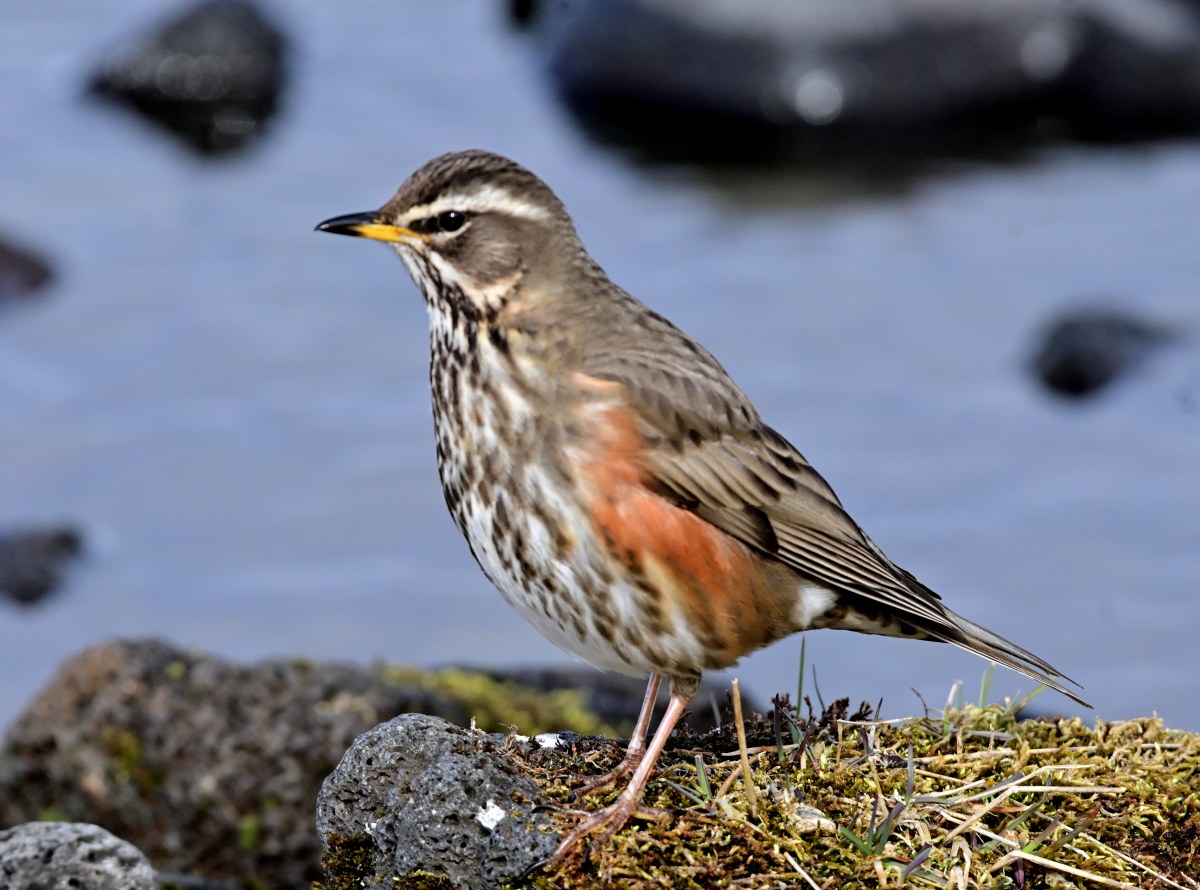
Skógarþröstur – Redwing – Turdus iliacus
The same goes for the Redwing, some stay here the whole year round, others go to the British Isles. As winters become warmer staying is perhaps not such a bad choice. Flocks of Redwings start arriving early, many in the middle of March. The Redwing always has a special place in the heart of the Icelandic nation, signalling the coming of spring.
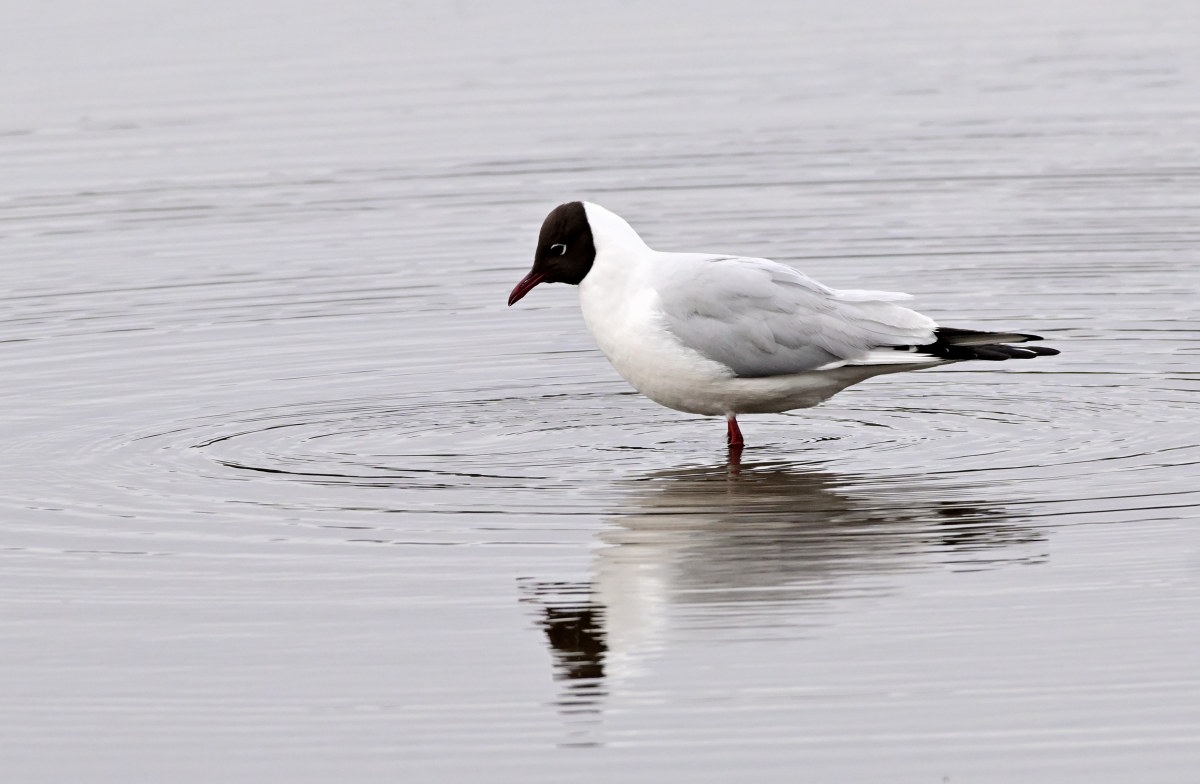
The Black-headed Gull is also one of the earlier arrivals, many staying in the sea around Iceland in winter. They do not go unnoticed with their black masks and their call that is loud and harsh, often sounding like laughter.
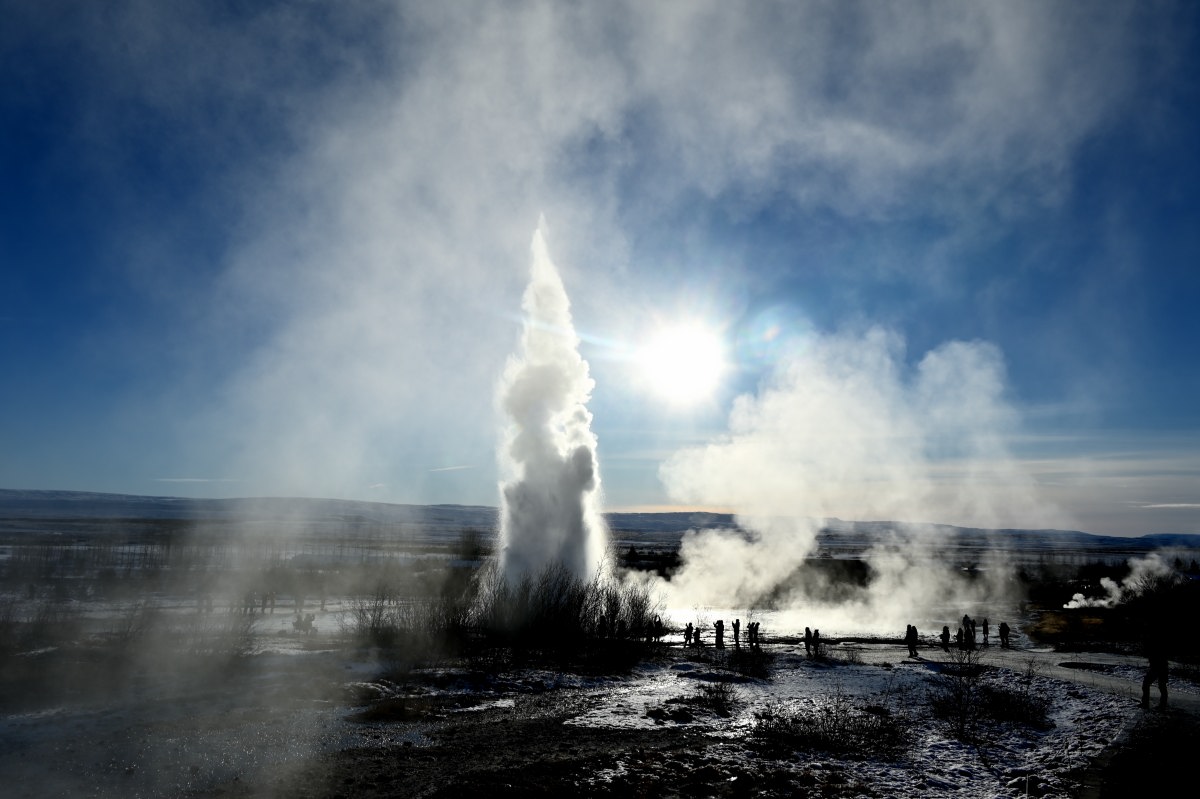
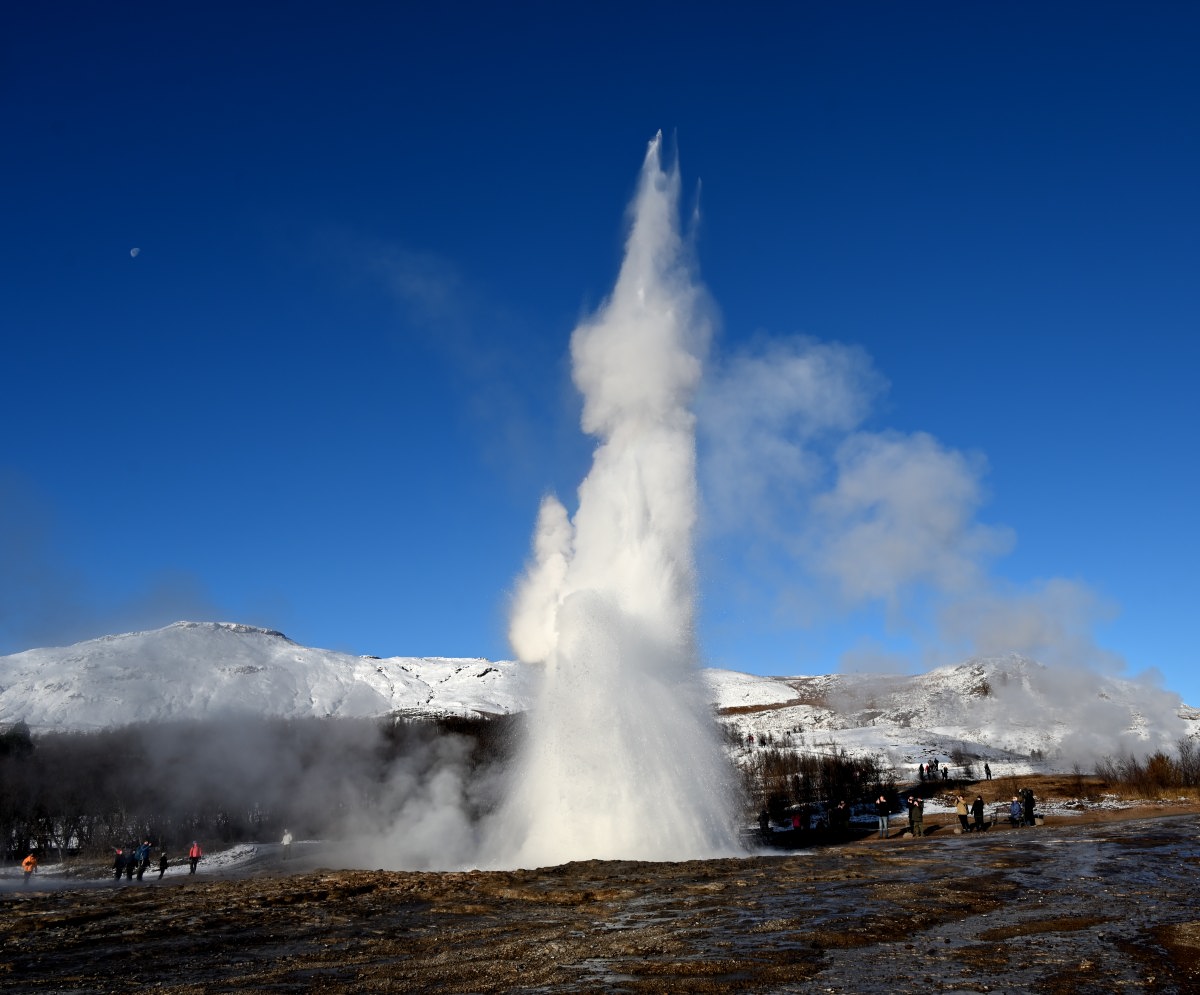
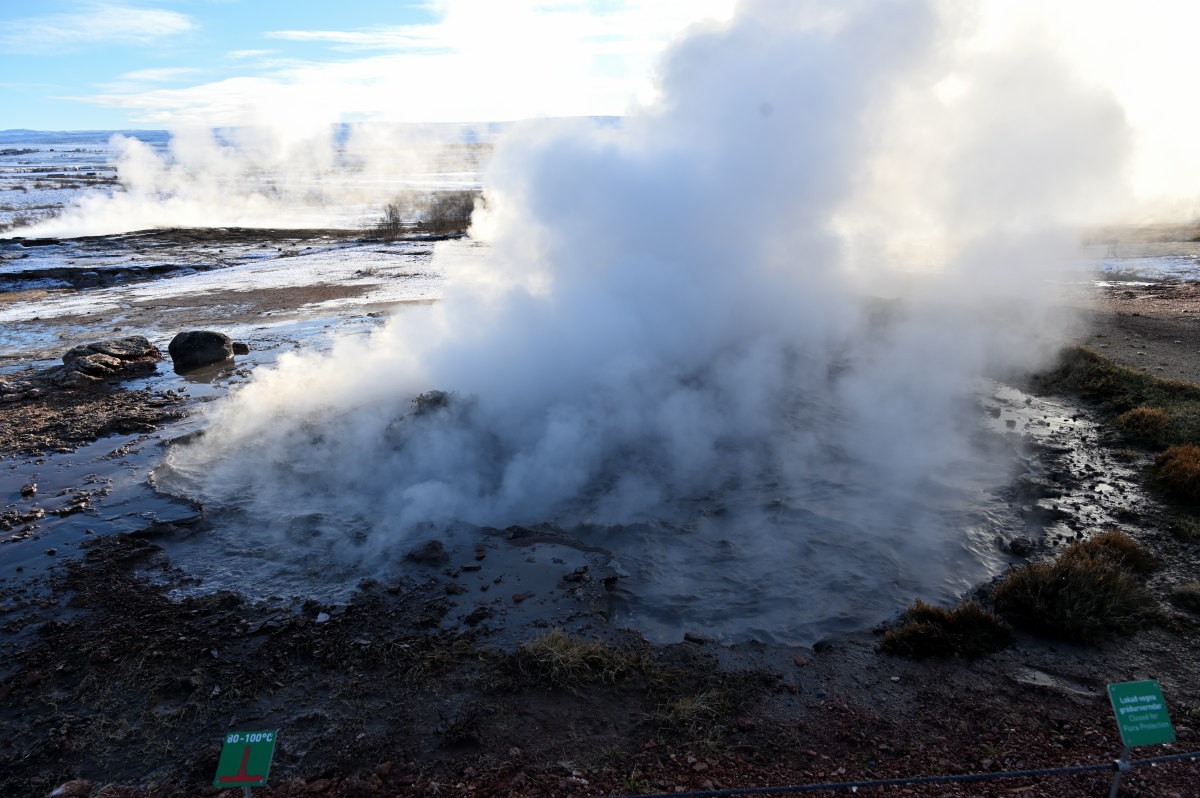
Increased activity was noticed in several hot springs in the Geysir Area on October 19. Monitoring of natural hazards did not reveal any reasons for these changes.
The Icelandic Environmental Agency and Park Rangers confirmed that the activity is more intense than it has been. The hotspring Strokkur drew special attention with steam explosions up to 30 meters high, more powerful and frequent than before throwing up mud and pebbles along the way. The old Geysir which the area draws its name from has, however, shown no changes.
Visitors to the area are cautioned to pay attention to possible dangers and keep a safe distance.
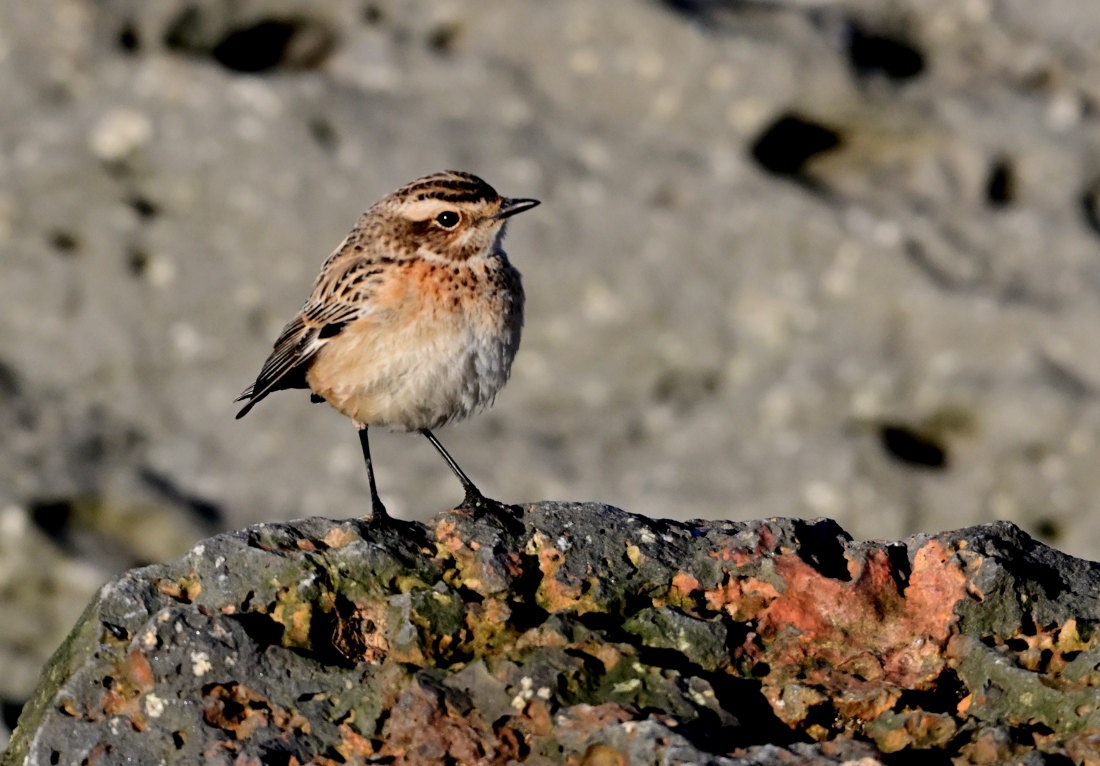
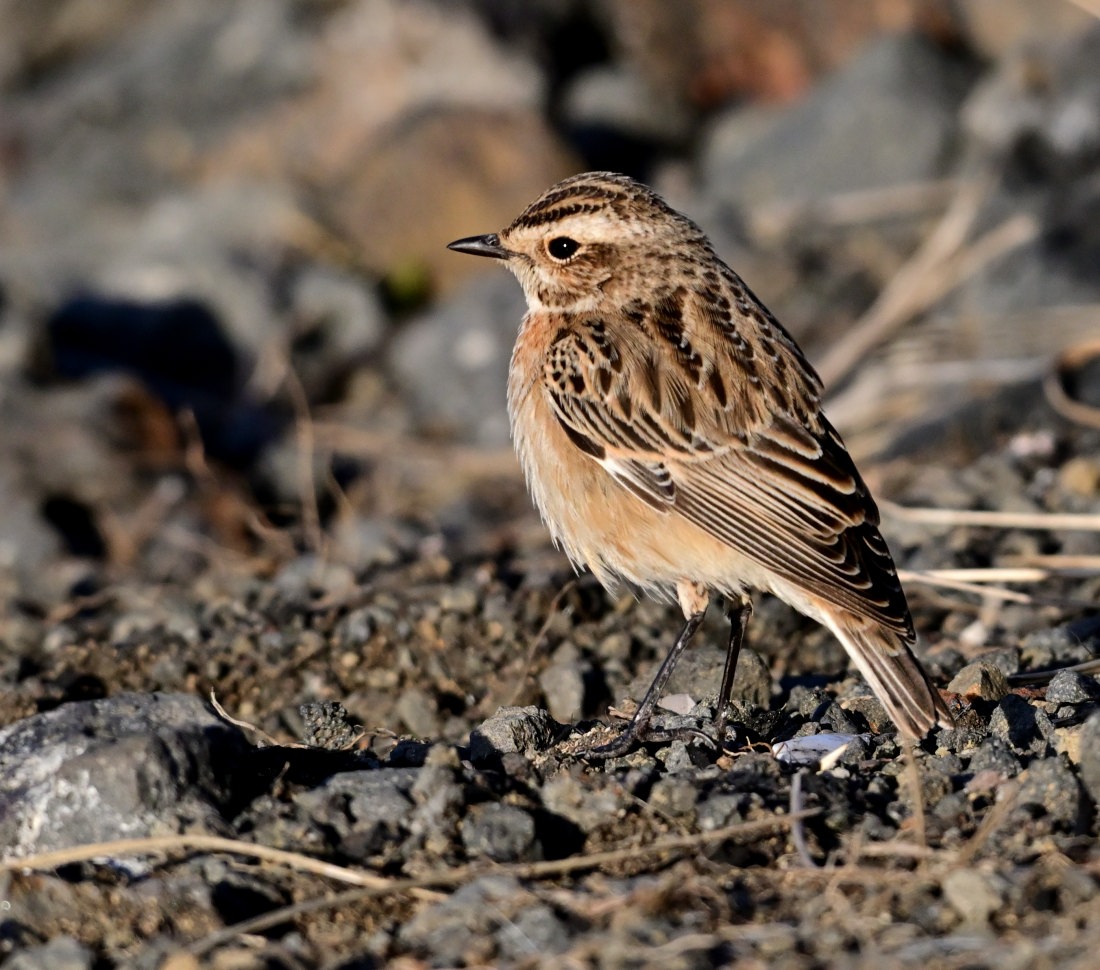
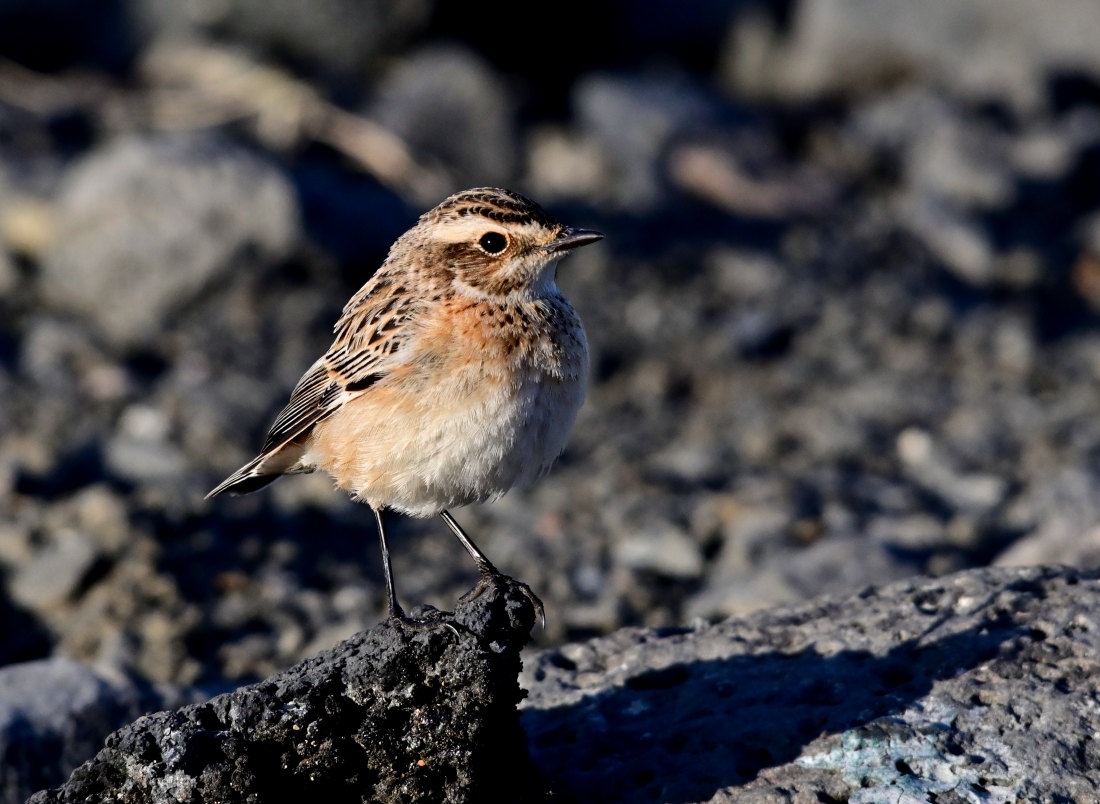
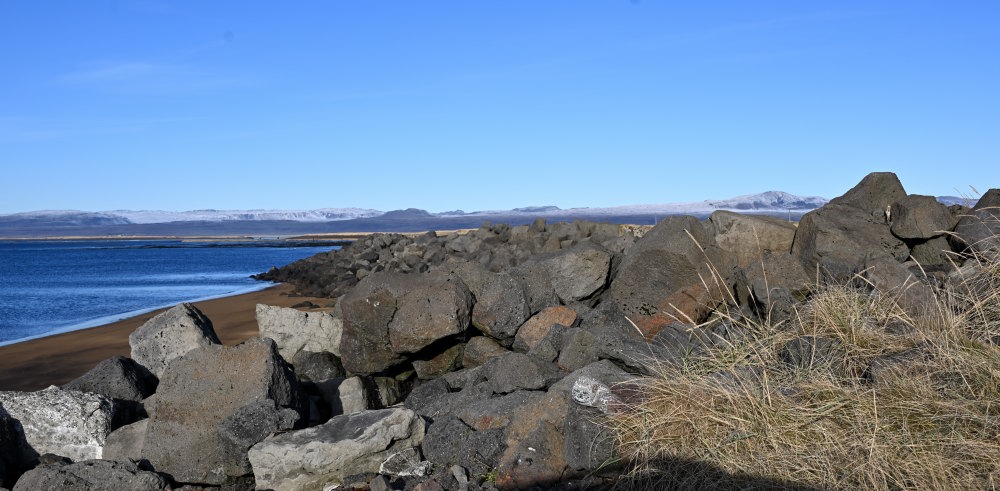
A Whinchat was spotted by Eyrarbakki harbour yesterday morning and today when I came there it was still there despite the cold. The last couple of nights it has been unusually cold and last night the frost went down to minus 8° C. So not a warm welcome to this little bird here in Iceland.
The Whinchat is a small migratory passerine bird. It is a vagrant in Iceland but a common breeding bird throughout the whole of Europe and Western Asia. Its winter grounds are in central Africa.
The Whinchat is a beautiful bird similar in size to the Robin. It was looking for feed by the shore in seaweed and some stone barriers west of the harbour.
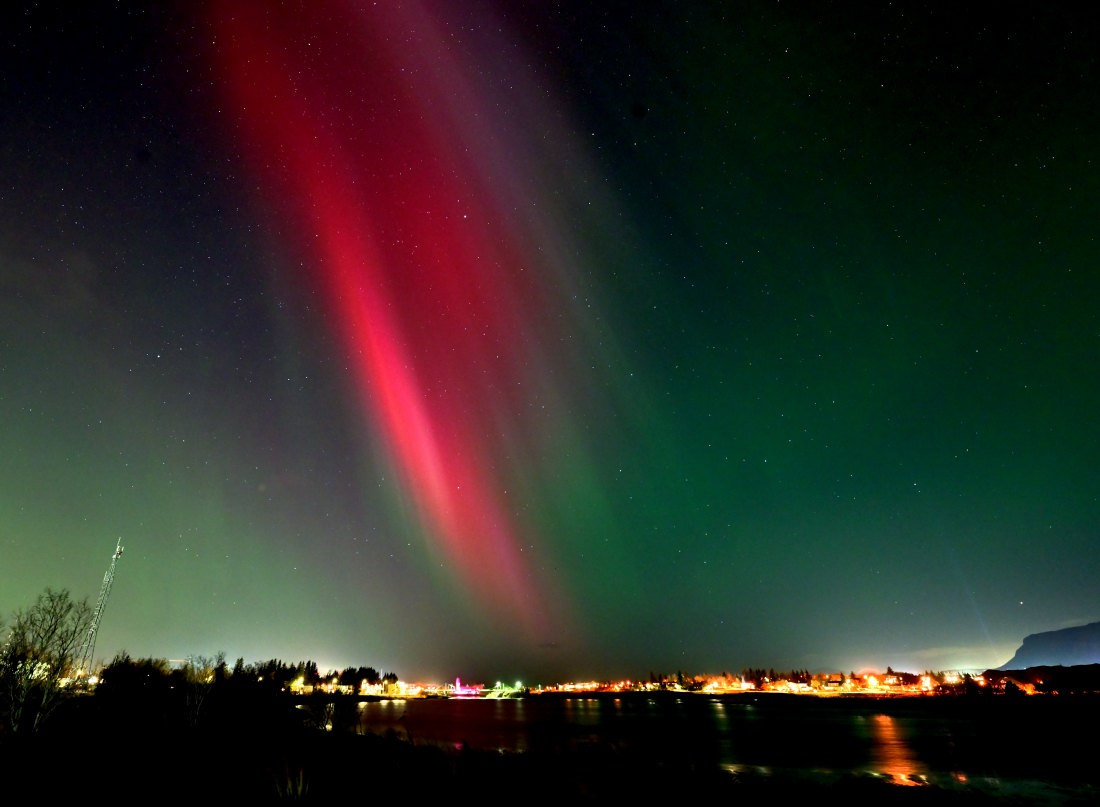
During the last five days there has been a peak in solar activity and geomagnetic storms have resulted in Aurora borealis being seen in most countries in Europe and as far south as California in the USA.
Here in Iceland the Northern lights have been magnificent for several nights, sporting colours seldom seen. The sky has been lit up almost like after a colour explosion. Red and pink being dominant which is not usually the case, whereas green as the most common.
The Northern lights have been so strong that the light pollution from the town does not interfere. These photoes were taken last night in Selfoss, South Iceland, between the hours 21 to 22, but the activity continued throughout the night until morning. For the next 24 hours, forecasts predict the same activity.